The Boat

Meditations from the Classics

Catullus
Carmina  (Poem 4)
The Boat

Catullus.Boat

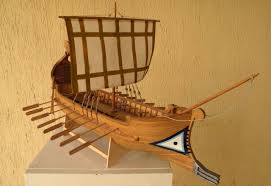
The Phaselus or boat described by Catullus.

Once there was a boat, said Catullus.

And what a boat it was! It knew, even while it stood among its fellow trees on a high mountain summit, long before it was ever cut and shaped into the form of a sleek ocean traveler, that it would be great.

Those ‘summit’ days were dreamy ones for the boat to be. Gazing out over the cliffs to the distant sea, it tasted the salt and felt the breezes sifting through its sails.

Then, as dreams are wont to do, the boat was born. Skilled artisans formed its hull, planted a tall mast on the firm deck, and raised its sails to the heavens.

Once the vessel hit the water

“…it flew upon the sea
and, birdlike, fled more rapidly
than all the rest. Swift ships have failed
to catch it when they raced with oar and sheet.
All met with quick defeat.”

     What a ship! said Catullus. It weathered all the storms with ease. Never beaten or conquered, it sailed with high spirits until, in time, it retired in a peaceful harbor at rest.

“She made her final odyssey
to this calm lake where she will stay
and age in peace and where she may
repose protected from the sea.
Sacred to Castor and his twin, this ship
has made her final trip.”

     In a way, the noble ship symbolizes the active Christian life. You sail through all life’s storms with eyes locked on the prize, depending on God to steer you safely to that place of rest. At times you might be unable to see the shoreline but remember that Jesus slept with repose in a boat on the stormy Galilean Sea, and you too can experience peace as the journey unfolds.

     “There remains, therefore, a Sabbath-rest for the people of God.  For the one who has entered His rest has himself also rested from his works, as God did from His” (Heb. 4:9-10).

David R. Denny  Ph.D

Photo credit:  https://latunicadeneso.wordpress.com/2013/08/28/la-reconstruccion-del-phaselus-un-barco-de-la-antigua-roma/

Prayer in Troubled Times

Waywords 

Elijah_w_Widows_Son_1080-256

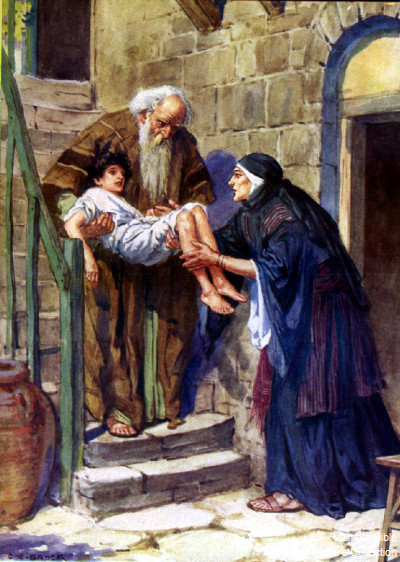
Elijah restores the widow’s son in Zarephath.

Prayer in Troubled Times
I Kings 17:17-24

The widow clung to the lifeless body of her son. All was gone now. The long sustained drought had wrung her soul dry leaving it crusted and crumbled. But at least through that horror, she had her son. But now he too was gone. The child had been her morning smile, her evening laughter, a reason for living. But now barren rooms in the small house were silent. He was gone, taken by some hideous sickness that struck without warning or mercy. And so all she could do now was to pace restlessly back and forth across the floor as if trundling from wall to wall could somehow erase the pain.

When Elijah stepped into the room, the widow’s reaction was instantaneous. She exploded, channeling a pent up rage at the prophet. “You call yourself a man of God? Look what has happened. My only son is dead. I took you in and look how you repaid me. It’s your fault he’s dead. You brought me bad luck. You put my son to death!”

The little widow turned the Prophet wanting only to be alone with her grief. Elijah, taken by surprise, paused for second to two and then stepped up to the woman. “Give me your son,” he demanded in a stern tone, indignation evident on his face. Elijah took the boy from his mother’s protective bosom and carried him upstairs to the upper room where he was living and laid him on his bed.

“Why, Lord, why did this happen?   Did you slay the boy?” The prophet pelted the Lord with edgy questions. He didn’t play games with God. He just wanted to know what happened, and he sought the core of the conundrum.

But then when the questions were exhausted, Elijah put aside his cross- examination of the divine mysteries and stretched himself upon the child three times. This time, he approached the Lord with a new intention. This time, he prayed. “O Lord my God, I pray Thee, let this child’s life return to him.

F. S. Webster said in his sermon Out of the Depths, “There are deep mysteries in life which yield to nothing but prayer.” And so it was that God heard this prayer and responded by breathing life back into the boy.

Elijah’s pattern of prayer is valid for us today. He prayed with a measure of frustration laced with honesty and doubts. Then he paused and prayed again with faith asking specifically for life.

So no matter how burdened your heart may become, let your final exhalation always be a prayer of faith and hope.

 David R. Denny Ph.D.
(Art credit:  http://bibleencyclopedia.com/pictures/1_Kings_17_Elijah_with_the_widow’s_Son.htm

Life in the Ghetto

Meditations from the Classics

Life in the Ghetto
Ancient Rome
Juvenal, Roman, AD 55-138
Satires III

subura-rome-illustration

Subura–A neighborhood in first century Rome.

 Juvenal, a first-century Roman poet who relished satire and found delight in mocking the Roman customs, described one of the blue collar neighborhoods just outside of downtown ancient Rome. Called Subura, he lived there for a while and hated it. Julius Caesar had a little house in Subura before becoming famous. Nobody lingered here longer than he had too. But alas many of the working poor had no escape.

Juvenal described it as a busy, crowded, noisy, dirty area brimming with crime, prostitution and endless trades such as shoemakers, iron-mongers, wool merchants, cobblers, etc.

One thing he particularly despised were the wave, of Greek immigrants that flooded this neighborhood seeking a new life.

“What I cannot endure, my countrymen, is Rome turned Greek!”

Juvenal looked down on these aliens. He said they couldn’t be trusted. They would do anything to please their masters in hopes of gaining power and possibly inherited wealth. They’re sneaky, and they like to become all things to all people just to reach their goals, he said.

            “He is anything and everything you please, all in one. Grammar, rhetoric, geometry, painting, or wrestling, prophesying, rope-dancing, medicine, and magic—he is master of them all. Give the word, and your hungry Greekling will climb the clouds.”[1]

As I read these lines over a few times, I thought I could hear a faint Pauline sentiment in the back of my mind. I thought a little more and then I pegged it: Paul said:

“For though I am free from all men, I have made myself a slave to all, that I might win the more…I have become all things to all men,[2] that I may by all means save some” (1 cor. 9:19, 22).

Say what you will but it sounds like the Greeks of ancient Rome were pretty versatile and ingenious. Paul seems to have done something pretty similar–blending into his surroundings to be more effective as a messenger of the Gospel.

Maybe we should all break out of our limitations and find more common ground with the world about us.

David R. Denny Ph.D.
————————-
[1]http://www.perseus.tufts.edu/hopper/text?doc=Perseus%3Atext%3A2007.01.0093%3Abook%3D1%3Apoem%3D3
[2] τοῖς  πᾶσιν  γέγονα  πάντα…

Runaway

Waywords

Runaway
Philemon 1:10:  “…that I appeal to you for my son Onesimus,b who became my son while I was in chains.”

runawayOnesimus was a man in flight.  A runaway.  He felt caged at Colossae where he had lived as a slave in a Roman world.  Though he wore no chains, life’s limitations smothered him.  Considered nothing more than chattel, he served solely at the master’s whims and commands.  Life was a brutal monotony of ‘do this, do that’, bowing and scraping, honoring the fateful code of a sycophant, smothering beneath life’s limitations.

For weeks Onesimus lay awake at night scheming, thinking escape.  He knew the risks.  Punishments were severe for runaways. The slave hunters (Fugitivarii) would be searching for him.  If found, they would brand him on the forehead with the letters (FUG), an abbreviation for “fugitivus” meaning runaway.”  His bones would be broken to prevent any future attempts at escape.  (http://www.tribunesandtriumphs.org/roman-life/slave-punishment.htm).  None of this stopped him.  Freedom called.  Its voice was sweet.  The temptation to discover a personal liberty, a future with options, was too strong.

So he fled.  He stole some money from Philemon and ran toward Ephesus 100 miles away.  Each mile was a milestone.  Past, Laodicea.  Past Hieropolis.  He followed the Meander River as it rolled through the Lycus Valley seaward to Ephesus.  After days of overland struggle, he arrived and caught a ship for Rome, the furthest place on his map.  No one would find him there.

Onesimus ran from life’s tortuous ignominy.  But somehow in a  city of nearly a million residents, he met Paul, the slave of Christ, the prisoner of Rome and in this serendipitous encounter found his ultimate freedom.  He and Paul become best friends united in Christ.  Paul considered him a unique son (ὃν  ἐγέννησα  ἐν  τοῖς  δεσμοῖς, –birthed while he was in chains).

If your life is tough and you can’t breathe and you’re thinking about running remember the story of Onesimus and draw comfort. Somewhere out there is a Paul, a friend who understands your grief and who wants to help you.  And in your lowest moment when all hope is gone, turn your heart to Jesus who knows the meaning of pain and isolation and who longs to be  your friend and Savior.

David R. Denny  Ph.D


Singing the Blues

Meditations from the Classics

Singing the Blues
Aristophanes, Knights

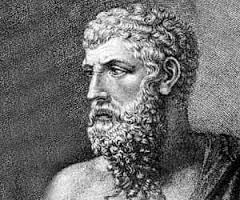
aristophanes

Aristophanes

(Greek comedy, 424 BC)
Acts 16:22-30

Demos, an elderly Athenian master, enraged by the gossip of a new slave he had recently purchased, turned his wrath on two veteran slaves, Nicias and Demosthenes. He beat them furiously. The new slave in the house, Cleon, had gained favor with the boss and told him a bunch of lies about the old-timers. Listen to them gripe and whine as they run from their most recent beating by the master:

Demosthenes:

“Ouch! How I hurt! …Oh, Lord! Goodness me!
That Cleon our master lately bought…
Confound him anyway, and all his tricks!
For, since the day he got into this house,
There’s been a perfect itch of beatings here…
How do you feel, my boy?”

Nicias:

“No worse than you, I’m sure.”

Demosthenes:

Let’s sing a sob duet to Olympus’s tune.”

 Both:

“Boohoo, boohoo, boohoo.”
(μυμῦ μυμῦ μυμῦ μυμῦ μυμῦ μυμῦ.)
http://www.perseus.tufts.edu/hopper/text?doc=Perseus:text:1999.01.0033

 Poor fellows. Two Athenian slaves who had it bad. The best they could summon within them was to break down and sob in perfect harmony with their pain. They remind me of two other men, slaves to a higher master as well, who likewise were rudely and improperly beaten. They too sang their pain away. But when Paul and Silas sang, it was a joyful duet about the majesty of God. Listen in—

     “And the multitude rose up together against them: and the magistrates rent off their clothes, and commanded to beat them. 23And when they had laid many stripes upon them, they cast them into prison, charging the jailor to keep them safely: 24Who, having received such a charge, thrust them into the inner prison, and made their feet fast in the stocks. But about midnight Paul and Silas were praying and singing hymns of praise to God…”(Acts 16:25).

What’s the name of your tune? “Sobbing the Blues” or “Praising the Lord.”

David R. Denny  Ph.D

Blue Light Special

Drummondtown Baptist ChurchBlue Light
May 29, 2016
Ephesians 5:16
The Blue Light Special

Introduction:

Come with me to Delphi, high atop Mt Parnassus overlooking the Corinthian

Gulf not far from ancient Corinth. I stood here many years ago before the grand Temple of Apollo that still stands on the top of Delphi.

There is an ancient story about a man who once came here for a message from the mysterious Sibyl who was a wild-eyed priestess of the temple who hair scattered in the mountain breeze. He paced restlessly before the temple doors waiting desperately for an answer to some life predicament.

He heard her wild incantation behind the doors and wondered what she would tell him. Finally, the creak of door hinges signaled the Sybil’s appearance. He stood transfixed below the portico and watched as she silently laid out a row of delicate leaves on the ground each leaf containing a word scrawled with a prophet’s pen.

He was excited. This is my answer, he thought. Then without a word or a blessing the Sybil slid back into the darkness of her sacred retreat slamming the door behind her. The man stood alarmed yet hopeful. But before he could scoop up the leaves and read the words, a breeze blew across the mountain top scattering the leaves, lifting them, sifting them, stealing them in a small delicate swirl of wind that devoured the prophecy.

*I see our text here in this great tragedy: The leaves are like Time—fragile, demanding immediate attention—easily blown away and lost forever.


Blue Light Special

            Paul tells us to walk into the marketplace and look for a bargain on Time ( ἐξαγοραζόμενοι  τὸν  καιρόν,).

*Once long ago I went to Kmart. Saw a flashing blue light. Asked about it. Everybody rushing to the light. I followed. Get real bargains they said if you act quickly. Candy bars. The last one was taken just as the light went dead. My hand was outstretched—too late!

Paul says walk with the utmost of care into the market and buy up Time before it slips away.

Three Blue Light Specials to consider. Act quickly. They will not last long. The blue light is spinning.

  1. Make time to help someone in need. Had the Good Samaritan not acted quickly to offer his help the poor man would have died on the lonely byway where he had been robbed and left for dead. —-All about us in today’s evil world there are people in desperate need. Find someone to help before it is too late.

            *Ta’nyla—Tough kid. Attitude. Barked back at me. –Mentor program—mocked it at first—Then I chose here—One day we sat and talked—she told me of her mother in jail. How shoe stated boxing.—Then we played a game of corn hole tossing and a strange little-unexpected bond formed. —A month ago—she got in a fight with a huge black girl twice her size. David and Goliath—Expelled. Sad email from her.   “I need your help. Could you write me a letter on behalf? They’re going to put in a reform school.” —My reply—Never saw her again but heard she got home schooling instead of reform school.

Find someone to help before the chance is blown away like leaves on the Delphic porch.

2.  Make time to forgive somebody. Life is too fragile to hold grudges. The Grace of God within us compels us to forgive others.

*I’m reading a fascinating book: Thomas Carlyle’s The French Revolution. A brilliant writer. He spent s summer writing what would be book one long multi-volume set on the French Revolution. He was proud of his effort. —Friend to read—left it at his fireplace. Maid tossed it into the fire. But Carlyle forgave the man and rewrote it from memory.

*1 John 1:9If we confess our sins He is faithful and just to forgive us our sins and cleanse us from all unrighteousness.

*Onesimus–a slave of Philemon from Colossae. Stole from his master–ran away. Found Paul in jail in Rome. Saved. Sent home with a letter. “Please forgive him. He’s a new man.

   3.  Make time to love someone deeply. (The blue light is spinning. You must act. Find someone to love.

My wedding anniversary was Thursday.   43 years! Math is difficult here since I’ve been telling everyone I’m 29 for so long I actually believe it.

*(My students can’t figure ages out. I tell them I’m 29 and they look at me after hesitating seem to accept it).

*I met my wife on Treasure Island in Lynchburg. First year of Lynchburg Baptist College. Liberty University.   Bonfire–Long hair. I ditched the girl I was with and walked with her to the fire and that was 43 years ago.

Find someone to love. When you learn to love someone deeply you begin to fathom the deeper love God has for you. John 3:16.

Loving others is the heart of the Christian faith. We see Jesus toiling beneath the burden of the cross as he carries down the Via Dolorosa to Golgotha. His love for us is why we are here today. His love changed our lives. And we are to pass on that love to others. Find someone to love.

Love thy neighbor as thyself, said Jesus. Find someone to love.

Love the lost. It’s the core of the Great Commission.

*My dad loved the Japanese. He was saved in Billy Graham crusade and when he was shipped off to Tokyo, the first thing he did was start a home Bible study for the Japanese. …He loved them. I went to sleep each night he held a study to the sounds of What a Friend we have in Jesus.

Conclusion:

These Blue Light Specials are like the leaves blowing away in the breeze. They won’t last long. Paul tells us to go into the marketplace and buy up Time. It doesn’t linger long. So make the most of your time and help someone in need—forgive someone–love someone in the name of God.
Obstacles

Waywords

Obstacles

Acts 13:6  They traveled through the whole island until they came to Paphos. There they met a Jewish sorcerer and false prophet named Bar-Jesus,…”

Every Christian journey has its share of obstacles. When Paul set out on his first missionary adventure, it wasn’t long before he stood face to face with an obstinate official named Bar-Jesus (Elymas).

obstacles

This reminds me of my old grandma’s outhouse in Georgia. When I was a kid, my family would visit Essie and I would have to get use

d to old time country ways, including the use of the outhouse. During the day it wasn’t so bad, but at night, without lights, the trip to the twilight zone was quite treacherous.

First, I had to step onto the back porch in the pitch black. With rotten boards and rickety steps, I took a real chance of falling through to the wet worm-patch below the porch. In the yard, there was a low-hanging clothesline

just waiting to hang any cavalier nightwalker out for a lark. There were holes in the dirt yard, big wood chips, and ax handles, and chickens to step over or around. And when I did get to the ramshackle outhouse, I ran the risk of snakes, or spiders, or worse–no paper.

Obstacles. That’s what these were. And in a way, that’s how it is for all who journey for the Lord today. Paul overcame this obstruction in Acts 13 by having the courage to face Elymas with faith and reliance in God. You can do the same things.

Happy journeys (and safe back-porch excursions).

David R. Denny  Ph.D.