Unleashing Everything

Unleashing Everythingbe-thankful
1 Thess. 5:18
November 20, 2016

There’s nothing worse than being unprepared for unexpected events.  This is what our text is teaching us all this morning.

–You’re walking your dog in the park.  The sun is out.  Your Irish setter is smiling.  The mockingbirds are quoting Shakespeare.  The black swans on the lake are fluffing their feathers. It’s a perfect day. What could go wrong?  And then you hear it.  A crackle of thunder.  And within seconds it’s pouring and your new Paris jacket is sopping wet.

You were unprepared for an unexpected event.

Now what I want to do this morning is to prepare you for the unexpected.

For example, you never know when a Greek tourist might stop you on the streets of Onancock and greet you and then hand you an apple.  He’ll say (in his greeting) “Kalimera sas.”  Good morning.–  And then he will hand you an apple and then will he wait for a polite response.  And this is where you want to be prepared.  I’m going to tell you how to respond.  Just say “sas efkaristo, (εὐχαριστεῖτε)  Thank you.

So now let’s try it.  I’ll be the little short Greek guy who gives you the apple.  And I’ll say  “Kalimera sas.”  And you’ll say,  —-sas efkaristo.

————–

Now I know that you probably think I’m of my rocker this morning talking about Greek tourists and apples and greetings etc. Bur text this morning uses this very word–thank you.  Paul says in the Greek text,  “In everything —say—sas efkaristo.  For this is the will of God in Christ Jesus for you.

In other words, it’s God’s will for you to say THANK YOU–sas efkaristo–to everything that comes your way.  EVERYTHING.

Not just the blessings of life.

Not just the joys of life,

but to the difficulties, and the sorrows and the unexpected tragedies that we don’t understand.  It is the will of God for you to say every day, every hour, every moment–sas efkaristo.

For when we give thanks for the good and the bad of life then we are one with God’s will for our lives.

—————

Helen Keller was born on June 27, 1880 in Tuscumbia , Alabama. When she was 19 months old, she contracted scarlet fever and soon lost her sight and her hearing. During her early years Helen Keller became wild and unruly. She would kick and scream. People told their parents to place in her in an institution.   But instead they hired a young 20-year old teacher named Anne Sullivan to work with her.   But the results were much the same until one day the unexpected happened.

Sullivan took Helen out to the water pump. She spelled out the word WATER. The she began pumping the water and as it rushed from the spout over Helen’s hand, Anne once again spelled out the word into her hand. That’s when everything changed. Helen figured it all out. So excited, she stomped the ground and demanded another word. And another. And another until by nightfall she had learned 30 words.

Helen Keller’s life demonstrates our text. For instead of living her life seething with anger over her disability, she instead spent each day giving thanks for it. In 1980 Jimmy Carter declared June 27, as a Helen Keller Day at the federal level.
_______________________

The title of my sermon is unleashing EVERYTHING. This is how our text begins. In everything…

Upon first reflection, I want to stop Paul mid sentence and protest. I think the conversation would go something like this:

Paul: In everything say sas efkaristo…thank you…

Me: Wait a minute brother Paul. Just stop right there. I mean that is not practical. Real people aren’t wired to give thanks all the time. You’re not living in the real world.

Paul: But David, that is God’s will for you. Don’t you want to follow’s God’s guidance for your life?

Me: I do but God knows I can’t give thanks all the time for everything. If I fall down in the street and hurt my leg I’m not going to jump up and say sas efkaristo. Not gonna happen.

Paul: Look, David. I’ve got a suggestion. Why don’t you start with small things. Give thanks for the food you eat. How about that?

Me: Well, I could do that.

Paul: And Give thanks for your family.

Me: Well, I can do that.

Paul: And before long you’ll find it natural and beneficial to give thanks when you fall in the street. And remember, that giving thanks in EVERYTHING is your goal. It is what God wants you to do.
—————

Daniel would never have stopped and argued with Paul like did. In Daniel chapter 6 we the most incredible example of giving thanks in the midst of a horrible personal dilemma. Daniel had just been promoted by Darius the Mede to the top management position in the land. Daniel was happy to give thanks in everything. and 3 times a day he stopped working and went home to his prayer chamber on the roof of his house. He always opened the window that looked toward Jerusalem and then he kneeled down and he gave thanks for his great good fortune.

Those who were jealous of his new power devised a plot to bring him down. They had the king sign a law than no one could pray to another God. But Daniel was undeterred.

Read Daniel 6:10———

What incredible courage! Knowing that the new law prohibited him to pray to his God, he defied this order and went to his prayer room at noon and gave thanks anyway. Knowing what would happen to him, he still gave thanks.
————–

Sometimes I’m a skeptic. I don’t always believe everything something tells me. So I found myself wondering if Paul really practiced this strange way of living–giving thanks for everything. So I opened the Bible and the pages parted at this text which I will read to you. (1 Corinthians 12:7-10).

Paul says in this Corinthians passage that he has seen things in a vision that were so glorious that words could not express them. And to keep him humble, God forced a thorn into his life. —Read (vs. 7-10).

When I heard Paul giving thanks for the thorn I knew that it was real for him and it could and should be real for us as well.

Conclusion:

*I used to walk my Irish setter Reverend early in the morning when I lived in Cheriton. I would leash him as I walked across 13 in the early morning fog. But when I hit the farmer’s field and was heading toward the Bay, I unleashed him and let him run. He would leap and bark with excitement. And would run after him. It was one of those man/dog moments.

I want all of us to learn to unleash EVERYTHING.

“In everything give thanks for this is the will of God in Christ Jesus for you.”

I want all of us to learn to say sas efkaristo through the good and bad in life. For then and only then will we truly be in sync with God and find the deepest meaning of happiness in our lives.

Photo credit:  http://allbackgrounds.com/be-thankful


Mission Impossible

1 Samuel 17:  41-51 (Ephesians 6:10-13)
Dr. David R. Denny
November 13, 2016

13-robert-wadlow

Robert Wadlow at age 22.  He was born in 1918 and stood 8″11″.

I was on my stomach this summer crawling through my garden. I was on a mission to pull weeds and I was determined to track each blade of crabgrass, every nefarious dandelion and bindweed and chickweed that I could find. Don’t you just love gardening? What could be better than crawling around in your garden on a pretty spring morning getting dirty and having a ball? Well as I was going about my weeding, I spotted something amazing that illuminated my sermon title for this morning–Mission Impossible”. I saw something impossible right in front of me. So, what did I see?  I saw an ant carrying a huge leaf in his jaw.

Now just in case you missed this lesson in Science class, let me remind you of a few ant facts: Ants weigh about 1-5 milligrams. Doesn’t sound like much but the combined weight of all the ants on Earth is greater than that of all the people! Now here is the kicker. Ants can carry loads up to 20 times larger than themselves.

Now this part of the sermon requires a little math so I don’t want you to panic or anything. Just multiply your weight by 20. Now this would be a good time to cheat on your weight if you want to. I weigh about 220 so times 20 would be about 4,400 pounds. To put it another way, this would be like a 150-pound person carrying around a compact car! And an ant’s neck joint can withstand a pressure that is 5,000 times that of his weight.

And so when I stopped pulling weeds long enough to admire the little ant carrying this huge leaf I realized that the impossible often happens in daily life.

————————————————————————————–

Our lives are often dotted with Mission Impossible moments.

  • Sarah laughed uncontrollably in God’s face when He said that she would have a child at age 90. Mission Impossible. But she did have a child–Isaac.
  • The Red Sea was a Mission Impossible Moment for Moses. But as the Egyptian chariots came charging across the desert, he stretched out his staff and split the sea.

And in our text today we see a young shepherd boy faced with something so improbable, so unlikely that had this event occurred today the Las Vegas bookies would have downgraded him to a thousand to one odds of killing Goliath and another Mission Impossible flits across the pages of Scripture.

As we look briefly at David’s story of courage and faith, I want you to look within yourself and ask yourself this question—what impossible challenge am I facing in my life right now? Have I lost my job? Is my marriage in trouble? Is my health failing? Have I got a huge test to take that might determine my future? Is there a big interview looming next week that might make or break my future?

And what about our church? Are there impossible goals we might want to set here? If an ant can do the impossible, can we with God’s help see our church grow? Impossible obstacles in your life and in our church can be overcome with absolute faith in God.

Goliath was huge. He was a human wrecking ball. He was simply undefeatable. (READ 17:4)—The Scripture says Goliath was 6 cubits and a span. A cubit was the tip of middle finger to elbow (1 1/2 feet) and a SPAN was thumb to little finger (9 inches)–we can get Goliath to 9 – 10 feet.

***Now just a quick textual note here. If you ever get to Israel and happen to stroll over to the location of the Dead Sea caves –13 miles East of Jerusalem–where the ancient Dead Sea scrolls were found make sure you look up at cave four. (MSS were found in 11 caves) It is the easiest cave to see from a distance and it is the cave where most of the scrolls were found. In this cave 4 the oldest Hebrew manuscripts for Samuel was found and in one it says that Goliath was 4 cubits. But the other manuscripts say 6 cubits and a span. Here is what happened. (Now you’ll have to step into my Hebrew class at the NOBTS)– The Hebrew number for 4 (4 cubits) is this: (MAKE HAND MOTION) The Hebrew number for 6 (6 cubits) is this——And so eventually 6 cubits became the standard translation which is 9 feet.

The tallest man in recorded modern history was Robert Wadlow who at age 22 was 8’ 11.1 inches. His father standing next to him barely reaches his waist.

Goliath was huge. 10 feet tall and all man and all muscle. He wore a scale armor that weighed 150 lbs. He had a huge bronze helmet and heavy bronze shin guard. Altogether his entire panoply of armor weighed in at 272 pounds. Plutarch tells us that the ordinary Greek soldier carried about 60 pounds.

Every morning and every evening Goliath came out into the valley of Elah and

shouted across to the Israelites to send him a challenger. He shouted this intimidating challenge for forty days straight. And for forty days straight no one dared to answer. The entire Israelite army quivered in fear and refused to see any possibility of success.

Now my observations in modern life place a large number of us in this valley of fear and paralysis. We see an obstacle before us in our lives but we can’t face it, or answer it or overcome it.

  • Why are the bars filled each night? It is an escape from the burdens of life, from obstacles people can’t deal with.
  • Why are we as a country consuming tons of drugs each year?
  • Why do over 20 million Americans suffer from depression?
  • I think most of us hit walls along our journey and we see no way over or around and we give up.

The entire army of Saul was locked in fright as they stared down upon this giant shouting curses at them.

  • Oh, where is the angel Gabriel when you need him. Don’t you remember what Gabriel to said to Mary as she trembled before an impossible challenge? He reached out to her, raised her face, gently looked into her eyes and said these immortal words; WITH GOD, NOTHING IS IMPOSSIBLE (Luke 1:37) Nothing! Nothing! No manuscript confusion here. No number 4/6 doubts here. Simple and straightforward. Straight from the lips of an angel who came straight from the throne of God—WITH GOD NOTHING IS IMPOSSIBLE.

Oh, if only Gabriel had fluttered down to the valley of Elah and touched the hearts of the quivering soldiers. I want each of you here this morning, whoever is at a mission impossible point, to hear the echo of Gabriel’s word. With God, nothing is impossible. God can and will help you through your problems. He hears. He understands. He is here for you.

I admire David so much. He heard the giant cursing and bellowing in the valley. He was instantly repulsed. The soldiers ushered him to Saul. “Here is a challenger,” they said. Saul, tall in his own right, looked down upon the little wisp of a kid, thin tanned arms, flowing hair, easy smile, determined eyes. “Are you sure? He asked.”   “Yes, I’m sure. God helped me slay a lion and a bear. What’s the difference?”

Saul loads him down with his heavy armor but David tosses it aside. “It is untested,” he says. And then David goes to the brook, selects five smooth stones, gathers up his sling and heads off to do battle with an impossible challenge.

We have to pause here and study David’s example. Facing an impossible challenge, he doesn’t panic or retreat. He remembers the victories God gave him in the past. He remembers and he draws confidence from them. You can do the same thing. Surely you too have some victory in your past. Maybe with God’s help, a relationship was repaired, or a deadline met or a job found or an addiction resolved. David remembered his past victories. They invigorated his faith in God. He did it in the past. He can do it now.

Now I want you to notice that David selected his weaponry with great care. He walked purposefully toward the small brook Elah. You can still see it today. It is about 10 feet wide and still filled with small stones. David selected 5. Each carefully examined. Some tossed back into the brook. The best five, the smoothest ones with the right weight and dimensions were carefully tucked into his pouch.

We too are taught by the Apostle Paul to select our weapons carefully. Victory can only be assured as you march against your impossible mission if you gather the right weapons. That list is documented in Ephesians 6 beginning with verse 10. Let’s gather some and tuck them into our shepherd’s pouch.

  1. Gird up your loins with TRUTH
  2. the Breastplate of RIGHTEOUSNESS
  3. THE GOSPEL OF PEACE
  4. the shield of FAITH
  5. The helmet of SALVATION
  6. SWORD OF THE SPIRIT

David, with his pouch filled with the hand-selected stones, raced toward the giant, whirled his sling round and round and flung the first stone right between the eyes. Goliath fell with a thud and the impossible was accomplished!

Conclusion:

Well, history is replete with mission impossible stories. Hannibal shocked the Roman world as he prodded his African elephants over the Pyrenees and down the Alps entering the heart of Roman territory with a vengeance.

Alexander the Great conquered the world by age 33.

But nothing was greater than this victory by the humble shepherd over the mighty Goliath.

And your victory against some impossible obstacle in your life can be achieved as well. and many victories I predict are on the horizon for Drummondtown if we will just take heart, join hands with David the Shepherd boy and Gabriel the angel and believe in the impossible.

  • Just hear the voice of Gabriel—WITH GOD NOTHING IS IMPOSSIBLE.
  • Remember thoughtfully the victories God has given you in the past.
  • Then select your weapons carefully and launch out to conquer the giant.

Inside the Winner’s Circle

1 Corinthians 9:24-27
David R. Denny

ancient Greek boxer.

Ancient Greek boxer.

This morning Paul orders every one of you here in the Greek stadium to approach the starting line. (I say ORDER because the Greek word in verse 27 is a strong imperative–RUN!) τρέχετε …You’re all expected to compete. There are no exceptions. The Greek text says clearly PANTES—everyone runs. Paul not only expects you all to run, he expects you to compete at the highest level. For that was absolutely the Greek standard. You trained for months, watched your diet, abstained from all practices that would lessen your effectiveness. You came to Olympia ready to win.

Now I have a few simple questions that any spectator would want to ask as they watch you line up: These are yes/ no questions. (Index finger wiggle means yes--little finger wiggle means no. Everybody practice first. Hands low so nobody can see).

  1. Are you in top shape?
  2. Do you plan to win? Do you have a place on your wall to mount the winning wreath?       (Run that you may win the wreath).      
  1. Did you write your acceptance speech in advance? **In ancient Greece, the winner of the race was honored. He was allowed to erect a statue in his hometown and to write an account of his victory.

All right. Now total up your answers. If you wiggled all yesses then you’re a model for all us. Would all my yes people please stand?—Hmm. It looks like we’re all candidates for improvement. Understand one thing though—PAUL ANSWERED YES TO ALL OF THEM. He makes it clear in this provocative text that he is highly serious about his calling, his conditioning, his zeal and determination to win at any cost.

**The Air Force used to have an exercise plan called the 5 BX. It used 5 basic exercises to get fit. It is no longer used today but in my dad’s era it was big. You only had 11 minutes to finish them all. You started simply by doing some stretching. Then you did your situps, then some awful back extension by lying on your stomach and rocking up and down. I hated those. Then came the push ups and finally the running in place. No cheating here. You had to get your knees high. –When I was in high school and playing basketball, I used to try to do them all.

Our text today is Paul’s 5BX. It is a call to action, a call to evaluate your spiritual calling and goals. Accordlng to Paul, every Christian is to be in the winner’s circle. There’s no joking around with Paul. He’s intense. He means business.

*My high school BB coach was just like this. He was a short stumpy Methodist man who made it clear on the first day of practice that by golly—(he used other words)—we had by golly—(other words)—win all our games. If we didn’t by golly (other words)—he would by golly–get us by golly–good.

One game at half time we were losing. We were all sitting in the locker room wondering where the coach was. Then suddenly the coach entered kicking the door open with his foot. He stomped right over to some folding chairs near us and began throwing them all across the room. We were dodging chairs and saying prayers at the same time.   That’s intensity–That’s Paul in our text.

I remember after the season was over, a scheme developed in my mind about the coach. I was gong to go into his office and confront him! —It took a long time for me to get the my nerve up but the day came when I did it! I marched right in there and looked him in the eye and I asked him point blank–Coach–are you saved?– I was into soul winning then. It was the hardest thing I ever did.    He looked at me like I was a Martian. I expected chairs to start flying at any second. Then he started laughing uncontrollably. When he was finished, he wiped his eyes and looked at me and said, “Of course I’m saved. I’m a Methodist. Now BY GOLLY –git out of here.”

Paul expects everyone of you (especially if you’re a Cub’s fan) to be in the winner’s circle. So I want you step into that circle for a minute and let’s see what it feels like. Let’s examine the items in this haloed space. They come right out of the text.

Glance at your text one more time and see if you can identify three essentials for winning. What are they? If you have a pen, write them down or just remember them.

  1. Runner’s shoes. The first thing I see in the winner’s circle is a pair of worn out running shoes. **I was looking at an ancient statue of Hermes, dated 350 BC. He is the inventor of foot races. He sits in a reflective position fit and resting. On his feet are winged sandals, just little wisps of leather that barely cover his feet.

In the Christian life, every believer is a runner. Every winner’s circle has a pair of running shoes. For the believer, running is the symbol for our spiritual lives. Running implies spiritual fitness, dedication, discipline and purpose. You can’t be a serious runner without these qualities.

*Just before I left school on Friday, I slipped into the gym whre the coach had a class still going. About 6o kids, half girls, half boys. He barked orders and they obeyed. “Boys, sit! Girls run.”–And the boys sat without talking and the girls ran. He blew his whistle. “Girls, sit! Boys, run!” And they sat and they ran. Then he blew his whistle. “Everybody come to the center of the gym and sit. No talking.” And they did. Then he got after them a little. “Some of you wren’t really giving it your all. This leads to bad health. And that leads to heart attacks.” etc etc..

There’s the attitude Paul is looking for in each you. He wants to see that intense determination to achieve the spiritual goals God has for your life. He wants to see you lacing up your running shoes each morning, heading out to the track, striding toward the finish line with full intentions of winning the race.

**running in Dephi stadium—

  1. Boxing gloves. Step into Paul’s winner’s circle and you see his boxing gloves.   They’re blood spattered, and sweat stained. Once again they represent his life, his approach to the goals God set before him, his obedience to the calling God gave to him. Paul shows us his gloves. Can you show Paul your gloves?

πυκτεύω — 1 Occ. (box).

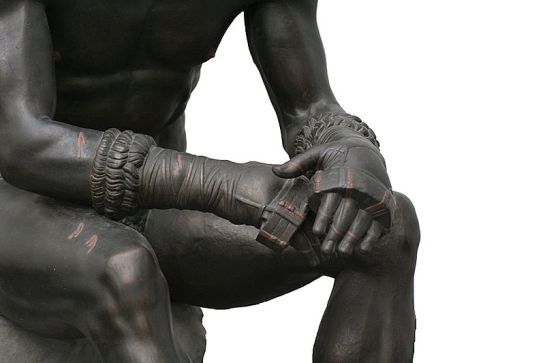
In the ancient world, boxing was a huge sport. It has a history that stretches back hundreds of years before Christ. In the original boxing matches two men would sit facing each and would beat each other with their fists until one of them was killed. —- But in later times boxers wore a form of gloves. They were called HIMANTES            These were thongs of ox-hide about 3-4 yards long that were wrapped around the hands and knuckles. The fingers were kept free. —There is a beautiful ancient bronze sculpture of a boxer sitting with his hands on his knees waiting for the match to begin. You can see the ox hide wrapped around his hands.

The rules of ancient boxing were simple: No finger gouging. No rings. No time limits. No weight classes. You were paired with an opponent by chance. You fought until you died or gave up by lifting a single finger.

Now let’s watch the great apostle Paul prepare for a bout. He strips down as was the Greek method. He wraps his hands carefully, methodically with the himantes—the leather strips. He faces the opponent. WHO WAS THE OPPONENT? HIMSELF!!

Paul fights himself. He says I buffet my body. hypōpiázō (/hypó, “under” and ōps, “eye”) – properly, to strike under the eye, i.e. giving someone “a black eye.”

This word is only used twice in the NT. It means to hit myself just below the eye. The Greek word for that very spot is OPS. It is the boxer’s favorite target.

Most of Paul’s battles in his Christian life were with himself. Isn’t that true for all of us? We might have our occasional battles with the world about us or someone in particular but our biggest enemy is usually ourselves.     (doulagōgéō (from /doúlos, “bond-slave” and /ágō, “to lead, bring along”) – properly, to lead as a captive.)   

**I’m not a great golfer but I follow the sport a little. And of course you can’t help but make a reference to Tiger. He wasn’t defeated by his opponents on the course. He lost to himself. Paul said, that he was not going to let that happen to him. So each day he boxed himself to knock out the enemy within. His biggest fear was that somehow he might find himself one day disqualified. (counterfeit coins)    (ἀδόκιμος, (δόκιμος) (from Euripides down), not standing the test, not approved; properly of metals and coin,…).

In the ancient games if someone cheated, the judges would come down and whip them publicly, fine them and then disqualify them. Paul feared that. And so when you step into Paul’s winner’s circle you see his shoes that represent his daily striving for the crown of victory and you see his gloves that he used for self-discipline).

  1. Wreath.

Now what’s the last thing you see in the winner’s circle? It is the prize—the imperishable wreath, the trophy for winning, for being the best. Paul says, when you run, run toward to the crown. When you box, box to win the crown.   (9:24—τὸ βραβεῖον;Only used twice–Means “umpire” or the arbiter of a sporting event. Then it came to mean “prize.” στέφανον

Paul kept this symbol of the prize before him at all times. Please take a moment to find a text. Look up Philippians 3:14. I press on toward the goal for the prize τὸ  βραβεῖον; of the UPWARD CALL OF GOD IN CHRIST JESUS.

The boxers and runners and javelin throwers and wrestlers and discus athletes all gave each contest their very best. They ran and boxed to win the wreath. But of course the olive wreath didn’t last long. The glory of the wreath was short lived. It was a treasure that faded away with time, like day lilies and roses in the fall air.

*A few years ago, a humble British laborer was out doing what he had done for 18 years. He had a bulky metal detector in his hand and he was walking over his field. His friends always mocked him because all he had ever found was a little scrap metal. Nothing more. But on this day as he unpacked his gear he repeated his little good luck mantra before he started: “Spirits of yesterday, take me where the gold is.”

That day he made one of the most important archaeological finds in British history. First he pulled one golden artifact out of the ground and then another and another. Before he was done he had filled box after box with 7th century Anglo-Saxon treasure worth millions today.

It is the ultimate prize for a treasure hunter.   But as great as this is, you won’t find anything like it in Pauls’ winner’s circle. The only treasure you’ll see there is the imperishable wreath, the never tarnished UPWARD CALL OF GOD.

What motivates you today? Is it a higher salary, a bigger house, a faster car? What get your blood pumping? Is it a big stock day, a huge promotion at work? Those things might have their place in the modern world but the Christian is to focus a different reality. We are to always be standing on our toes looking past these temporary wreaths toward the glories of heaven.

Conclusion:

All right. What’s in the winner’s circle?

We have the runner’s shoes,

the boxer’s gloves

and the imperishable wreath.

I hope as you go about your duties this week you will repeat these three items to yourself. Visualize them in your mind. Let them guide you and motivate you to strive to the highest level for Christ.


https://en.wikipedia.org/wiki/Ancient_Greek_boxing

Beach Treasures

Matthew 4:18-22
October 2, 2016jdlockhart_beachtreasureswindchime_5

I’ve got a simple question for you this morning. What is the best thing you’ve ever found on the beach? Finding things buried in the sand is one of the great simple pleasures of walking on the beach. The waves tumble in and stir up lots of little creatures that scurry about and bolt for cover. Sometimes you might see a crab snapping his claws as he backs away slowly. Or a big dead fish some fisherman tossed over board. And of course there are all those delicate shells that glisten with a captivating iridescence when you hold them up to the sun.

**For six years I served a church on the Eastern Shore. One of my favorite past times was to walk the beaches on the Bay with Alice and my Irish Setter. (I hesitate to tell his name but I guess I’ll come clean. I named him Reverend since I never liked to be called reverend).  There was a secret spot near the Bay Bridge Tunnel where I used to go. Mr. Boze Kellam, one of my members, had a potato farm that stretched to some huge bluffs that overlooked the Bay. One day he took me on a ride through the fields in his old pickup down to the bluffs and showed me a secret path through some woods that led down a narrow trail to the beach. I used to go there. (I’m going to break with church protocol and show you the picture I took myself of this magical spot).***************

I walked beneath a chimerical canopy of interlocking tree branches breathing the salt air that hung heavily in the trees. The trail was speckled with sunlight and the mood was surreal and enticing. It was magical under the dark canopy. But in a minute or so I emerged into the brilliant sunlight and there suddenly was the blue Bay with roiling white caps. I followed an almost hidden trail down the cliffside, the little sandy steps crumbling beneath my feet until I tumbled out on the beach as white as Christmas snow. As I walked closer to the water the sound of the surf grew louder and broke over the glistening beach. I stood there just staring at the wonder of it all. (How you could you not love the Shore)?

This particular day followed a storm the night before. and there were traces of debris washed up here and there. Alice had gone on ahead of me and had spottoed something just barely protruding from the sand. about 10 feet from the water’s edge. I saw her bending down diging so I joined her wondering what she had found. (If this was my class of kids I would have them all guessing what it was it was but I know you’re all too sophisticated for that–right)? I began to dig and after a few minutes I yanked up out of the clutches of the beach a perfectly preserved—What? Anybody know?)—a ships wheel. Oh how my imagination soared and I wondered where in the world it had come from.******Hold it up. I just happened to have it here and I thought I would show it to you.

——————————————————————————————–

As we turn our attention back to our text, we see Jesus doing something similar to what I just described. He was strolling along the beach by the Sea of Galillee. The Sea is about 13 miles long and 8 miles wide (about as wide as the Shore). The Sea has always been considered by ancients and moderns alike as a jewel of nature. Josephus, the remarkable first century historian, said this about the Sea:

“Seen from any point of the surrounding heights, it is a fine sheet of water, a burnished mirror set in a framework of surrounding hills and rugged mountains, which rise and roll backward and upward to where hoary Hermon hangs the picture on the blue vault of heaven.”

There are some beautiful pictures on the internet of the Sea today. It shows manicured rows of fruit trees running almost to the shore with the mountains in the distance. (When I visited this spot years ago I tasted some of the fruit grown by theSea and it was amazing).

It was along these beaches that Jesus was walking early in His ministry. And as He strolled along he too discovered treasure. It was a common sight to see fishermen at work along the shores. Josephus tells us that at the time of our text there were 230 boats regularly working these waters. So along his day stroll He would have passed boat after boat with fishermen scurrying about, some mending nets, some hauling in the night’s catch some standing and bantering about news of the day or some family issue.

He too had His own thoughts. His life was completely changed now. He had just been baptized in the Jordan by John and had launched His public ministry. The die was cast and He knew that His days were numbered and that every moment counted. His every deed, His every word, His every action had meaning and purpose.

*That is one thing I am becoming more aware of as I slowly get older. Time becomes more and more important as birthdays multiply. As we get older, we become more reflective. We value time differently. We see the tunnel of life narrowing and we focus more on the important matters of life.

Surely some thoughts similar to these would have crossed the Savior’s mind as he walked the shoreline beside the Sea of Gallilee. But then in the midst of his strolling contemplation something startling happened. He stopped and noticed two fishermen casting a net into the sea. ——-This net was a smaller circular net that would be tossed like a lariat in great circles and then released over a small school of fish several yards away. The weights would plunge the net to the bottom and capture the fish. The word used for this net in this text is ἀμφίβληστρον and it is used only one time in the Bible. There are other more general words for nets used even in our text here. But this unique net—the amphiblestron—is the one that Andrew and Peter are using. And as Jesus stands and watches the skillful tossing of the net He knows he has found beach treasures. I found a waterlogged helm; He found two fishers of men!

What is it that Jesus sees in these two fishermen that so intrigues Him? This isn’t the first time Jesus has seen them. In fact, these men have already supped with the Savior in His home. Simon and Andrew had been followers of John the Baptist. But John had introduced them to Jesus and Andrew and Simon had followed the Lord home and spent time with him conversing and getting acquainted.

­And so now as Jesus observed them casting their nets into the sea He had time to reflect on them. He realized that these were the very kind of men who could help Him establish His church and further the work of the Kingdom. And so like treasure on the beach, he harvests two disciples from the sea. “Follow Me,” he shouts to them across the water, “and I will make you fishers of men.” What a startling proposition. But something was burning in these two brothers ever since they had spent the day with Jesus at his home. And so when the call came it was almost as if they had been waiting, hoping, expecting it. And without hesitation they left their nets behind. The Greek text says they left εὐθέως (immediately). No hesitation. The decisions had been made earlier.

And then down the shore they went, a little band of brothers committing to the unknown, plunging into the mysteries of discipleship, a life without the typical certainties of fishing, without a clear routine. And before long they stopped and Jesus once again picked up his net ἀμφίβληστρον  and flung it like spindrift (my word of the day–the spray from a wild ocean wave breaking on the beach) over two more treasures in the sea. Jesus cast his net and hauled in two more men whose lives would never the same —(James and John his brother who were mending nets with their father). The Master fishermen hauled in four prize possessions and promised to teach them the secrets of fishing for men. And when the sun set on the Sea of Galilee Jesus had plucked four treasures from the sea.

—————————————————————————————

Now it’s time to turn this story toward us for a minute. I want you all to gather up your belongings–get your purses and your Bibles and anything lying beside you and lets walk on down to the beach where Jesus waits for us. It’s like a field trip. Let’s go on a field trip! My school kids love getting out of the building. We’ll go on a field trip and kick our shoes off and step on into the water. Not the Bay we know here. Not Onancock or seaside surf. No let’s step into the Sea Jesus knew intimately and pick up our nets. Be ready now for Jesus is coming. Yes, this is better. Now we aren’t just reading the story of Matthew 4; now we are in the story. And this is how it should be. Now it’s more personal. Now it’s you and me and and the Sea and the nets and Jesus standing on the shore. Now it’s real. And He’s ready to toss the net over you.

But I have to stop here and prepare you for this moment. Do you qualify to be a fisherman for the Savior?

There are a few conditions you must meet to successfully enter this story and join Simon and Andrew, James and John as fishers of men.

Please answer yes or no to these questions and try to be honest:

  1. Do you have absolute confidence that this man standing on the shore calling out to you is in fact the Savior of the world, is in fact your Savior? In other words do you believe in Him with all your heart? For without this belief you cannot join him and you will not feel the net tumble over you. Please answer YES or NO.
  1. Are you able to love someone other than yourself? Or are you a narcissistic person capable only of your own interests? “For God so loved the world…” the Bible tells us. Are you able to look beyond yourself to the world about you with sympathy and love? YES or NO.
  1. Do you believe in miracles? Do you believe God can touch a hopeless man or a broken woman and breathe life into them? In other words, do you believe in mirabilia–miracles of salvation? YES or NO.
  1. Finally, do you believe Jesus who holds the net can toss it over you and use you to change lives? Is God able to imbue divine love into your heart and divine power to touch others? YES or NO.

Now, tally up your score card:

If you answered YES to these questions then you qualify to be a fisherman aloang side Peter and Andrew. Remember, there were 250 fishing boats on the shores of the Lake. Jesus didn’t call them all to serve Him. He called those whom He knew would make effective servants in work of the Kingdom.

The challenge of our text this morning is to become a fisherman, to love Jesus and fish in His name for the lost about us.

 Conclusion:

I would like to conclude this message this morning with a little side thought to this sermon:

Thirty years ago- in 1986–I first came to the Eastern Shore. It was then that I walked along the shoreline and found an old helm buried in the sand. Today I feel as is I have stumbled upon a greater treasure. It rose several months ago from the sand like the spokes of a hidden helm. It was hard to recognize at first as if I was looking through a glass darkly and I couldn’t make out its shpe or meaning But as I explored and investigated and made repeated visits here to the Drumondtown Baptist Church I pulled you up and saw you for who you really are–a great treasure that God has blessed me with late in my life. You are my treasure on the shore. And I give thanks to God for this great discovery.

David R. Denny  Ph.D.
Drummondtown Baptist Church

Picture by:http://jaclyncarace.blogspot.com/2012/07/beach-treasures-wind-chime-diy.html


Murder on the Orient Express

Drummondtown Baptist Church
August 14, 2016
Acts 9:1-6
(Begin with reading verses 1-2)–

This morning I am going to lead you into a world of murder and intrigue. The panorama will not be a pretty one. It requires a warning to all in attendance today: The following scenes in this Biblical story contain graphic violence and might be disturbing to some viewers. But then the world of the New Testament was a violent place as nations and powers fought for supremacy (in much the same way they do today).

This morning we will follow the bloody footprints of Saul the murderer φόνου and religious fanatic down an oriental road toward a destination that if fulfilled will culminate in the destruction of many innocent lives. For make no mistake about it, Acts 9 begins with black intentions and the scent of blood lies heavily on these early verses. Saul is stalking his prey like a hunter pursuing big game.

 (Σαοὺλ  Σαούλ,  τί  με  διώκεις; Acts 9:4)–Why are you hunting me, stalking me?)

             *Perhaps one of Agatha Christie’s novels will set the proper mood. First published in 1934, Murder on the Orient Express told the story of a brutal murder of a fugitive criminal on a train departing Constantinople. Detective Poirot boards the train and settles in for a comfortable evening of rest in his sleeping berth. But in the middle of the night, he hears a loud noise. He eventually goes back to sleep but the next day it is discovered that a passenger has been murdered, stabbed 12 times. It is (just like our text today) a bloody scene. There are 12 people on the train and each one is a suspect.Murder on the O Express

Mr. Poirot is urged to take the case and find the murderer. The case proves to be a challenge. None of the facts seem to make sense but in the end, he discovers a startling reality, a reality that we actually see in our text this morning. He discovers that each of the 12 passengers is guilty. Each passenger had in fact stabbed the fugitive one time in the middle of the night venting their rage and hostility upon him for kidnapping and then murdering three-year-old American heiress Daisy Armstrong. These 12 upstanding members of society each had some personal link to the little slain girl and her family and each decided they would stalk the fugitive and take murderous revenge.

Now come back to our text. I see the same cauldron of boiling emotions. For Saul is a man possessed with murderous intentions. (The word in verse 1 in the Greek is best translated SLAUGHTERER–Saul the slaughterer. He hates Christians with a passion and makes a focused commitment to track them down. You, had you lived in Saul’s day, would surely have been his targets. Drummondtown would have been on his list. Even now as I stand and preach someone would have to be at the church door on lookout. Which one of you will guard the door? We would have practiced our escape route out the back. We would worship in fear and live in uncertainty. Saul was a hunter and you would be his prey.

Maybe some of you are thinking I’m exaggerating a little about his cruelty. Maybe you feel a slight twinge of sympathy for Saul. Then let’s go back a few verses to Acts 7:58–8:3 and see this same Saul clapping with glee as Stephen is stoned to death. The Jewish fanatics were laying their robes at his feet, partially disrobing so they could lift and throw a barrage of fatal stones upon Stephen. (Acts 8:1)–“And Saul was in hearty agreement with putting him to death.”   —-And remember, Saul hears the pious Stephen praying to Jesus and offering forgiveness to his attackers. And yet still, Saul laughs at this death scene.

Many years later when this same Saul had matured he looked back on this episode and recounted the gruesome murder of Stephen in macabre detail. Listen to his words in

Acts 26:9-11. READ TEXT

            And so now we see the vicious portrait of this criminal named Saul. Should he have lived in our day he would be on death row right now awaiting the gas chamber. But in his day, in the culture of the Sanhedrin, he was a hero and was unleashed on the heretics.

And so our text begins with a brutal close-up of a man on a mission. He is breathing threats and murder against the disciples of the Lord (Acts 9:1). The word for breathing out is a word used often by the Classical Greek writers of violent anger. It’s a word that you can hear. It is heavy breathing. Hot breathing. Vitriolic breathing that flushes the face and fills the eyes with visible rage.   Saul was “breathing heavily.”

*I’m not much of a wrestling fan but the other day I was changing channels and I paused on the wrestling channel. I was going to flip on but I got caught up in the drama of two wrestlers. One guy’s name was Big Show. 7 feet tall, 455 pounds (two of me!), with a size 22 shoes and a 64-inch chest. –I should have kept flipping the channel and continued looking for my nature show on delicate Monarch butterlies.

But…There he was looming high over the wrestling canvas–BIG SHOW. He was vowing revenge on another guy for saying something ugly about his mother. And so in the hype before the big match the camera zoomed in on his face and he was snarling and breathing heavily, almost gasping as he struggled to hold his anger in for the interview.           This was Saul. Hear Saul breathing. Follow him down the Oriental road he travels to Damascus. He struts with long strides carrying orders from the Sanhedrin to capture saints, men, and women in Damascus. His intentions are black. His goal–drag saints back to Jerusalem for slaughter.

Now let’s take our remote and pause the action here and look closely at this angry man on an angry road. I want to ask all you here at Drummondtown Baptist Church a theological question. It’s a question that anchors our core beliefs. Could God, would God ever love a man like this? Could Jesus ever seek a man like this? (Could you)? Is there anything redeemable in a man like this?

Nowhere in all of Scripture is the mercy and love of God seen more fully than in this story. For before us, charging down the road toward Damascus is a man not so different than you and me. For the Bible is quick to declare this truth; “For all have sinned and come short of the glory of God.”  (Could you repeat this verse with me)?

For this story to have the truest meaning you must see yourself as Saul on the oriental expressway to Damascus. You must see yourself as a sinner unworthy of any mercy or grace. You must see yourself as God sees you. Romans 3:10 holds an accurate mirror up before us.

(Romans 3:10-19)—Paul quotes from Psalm 14:1-3 Read this text.

            If you can place yourself on this road with Saul and see yourself as completely void of any righteousness then you will able to experience the wondrous miracle that is about to befall this murderer.

It was about noon Damascus time that Saul suddenly saw a light from heaven flash around him. READ TEXT-ACTS 9:3-4

And in that split second world history changed forever. In that moment salvation hit Saul like David’s stone hit Goliath. It rocked his soul, shook his heart, knocked him off his feet. (It was if you want to learn a new word, a sockdolager–a decisive blow). Do you remember my last word–velleity–a dream you do nothing to achieve)

He never knew what hit him. He went from breathing heavily, hyperventilating with anger toward the saints, to lying bent and broken on a dusty road. And if ever there was a picture of the reality of salvation this would be it. A life rushing at breakneck speed in one direction smacks dead into a loving God who is charging full speed toward the sinner.

            **If you ever happen to be near Geneva Switzerland you might want to check out the Hadron Collider.  It’s the world’s largest and most powerful particle collider, the largest single machine in the world. It is 17 miles in circumference and buried nearly 600 feet underground. The goal is to smash particles into one another at super fast speeds and discover the secrets of atoms.

This is what happened on the road to Damascus. Two forces collided and the sparks of salvation burst into the soul of Saul– sinner of the worst degree.

Saul must have been so bewildered. He has just had a conversation with Jesus, the very One he had spent his life hating. Now this very Jesus has knocked him to the ground and questioned him. “Saul, Saul, why are you hunting me down like an animal?” And Saul had no answers. All he knew to do was surrender. And in an instant he went from breathing threats and murder to loving mankind and devoting his life to sharing the love of the Gospel. And so finally my sermon reaches my culminating point with this question:

Have you met Jesus on the road to Damascus? Have you collided with the Love of God?

 *When I was seven year old my dad moved our family to Japan. He was in the Air Force. At first we lived off base in a real Japanese village. We had a Japanese maid. I remember her so well. Asuka was my friend. One day she was sweeping the back porch and I heard a sad song on the radio. “What does the song say?” I asked her. And she paused and thought and then continued to sweep while telling me the meaning of the song. She was so kind.

It was not long after we arrived in Tokyo that we began attending the Tokyo Baptist Church.  I used to sit in the balcony and send paper planes fluttering down toward the worshippers.

But one Sunday I remember when I was about 7 years old I was sitting on the main floor near the middle of the sanctuary. When the service ended Milton DuPriest who was the pastor began urging people to come forward and surrender to Christ. I felt like I could not stand still another second. I moved out from the pew and made the long walk to the alter and there I gave my life to Christ.

Have you surrendered your life to Jesus? Has your life collided with the love of God as Saul’s did? If not do it now.   Life is too short to wait any longer.


Blue Light Special

Drummondtown Baptist ChurchBlue Light
May 29, 2016
Ephesians 5:16
The Blue Light Special

Introduction:

Come with me to Delphi, high atop Mt Parnassus overlooking the Corinthian

Gulf not far from ancient Corinth. I stood here many years ago before the grand Temple of Apollo that still stands on the top of Delphi.

There is an ancient story about a man who once came here for a message from the mysterious Sibyl who was a wild-eyed priestess of the temple who hair scattered in the mountain breeze. He paced restlessly before the temple doors waiting desperately for an answer to some life predicament.

He heard her wild incantation behind the doors and wondered what she would tell him. Finally, the creak of door hinges signaled the Sybil’s appearance. He stood transfixed below the portico and watched as she silently laid out a row of delicate leaves on the ground each leaf containing a word scrawled with a prophet’s pen.

He was excited. This is my answer, he thought. Then without a word or a blessing the Sybil slid back into the darkness of her sacred retreat slamming the door behind her. The man stood alarmed yet hopeful. But before he could scoop up the leaves and read the words, a breeze blew across the mountain top scattering the leaves, lifting them, sifting them, stealing them in a small delicate swirl of wind that devoured the prophecy.

*I see our text here in this great tragedy: The leaves are like Time—fragile, demanding immediate attention—easily blown away and lost forever.


Blue Light Special

            Paul tells us to walk into the marketplace and look for a bargain on Time ( ἐξαγοραζόμενοι  τὸν  καιρόν,).

*Once long ago I went to Kmart. Saw a flashing blue light. Asked about it. Everybody rushing to the light. I followed. Get real bargains they said if you act quickly. Candy bars. The last one was taken just as the light went dead. My hand was outstretched—too late!

Paul says walk with the utmost of care into the market and buy up Time before it slips away.

Three Blue Light Specials to consider. Act quickly. They will not last long. The blue light is spinning.

  1. Make time to help someone in need. Had the Good Samaritan not acted quickly to offer his help the poor man would have died on the lonely byway where he had been robbed and left for dead. —-All about us in today’s evil world there are people in desperate need. Find someone to help before it is too late.

            *Ta’nyla—Tough kid. Attitude. Barked back at me. –Mentor program—mocked it at first—Then I chose here—One day we sat and talked—she told me of her mother in jail. How shoe stated boxing.—Then we played a game of corn hole tossing and a strange little-unexpected bond formed. —A month ago—she got in a fight with a huge black girl twice her size. David and Goliath—Expelled. Sad email from her.   “I need your help. Could you write me a letter on behalf? They’re going to put in a reform school.” —My reply—Never saw her again but heard she got home schooling instead of reform school.

Find someone to help before the chance is blown away like leaves on the Delphic porch.

2.  Make time to forgive somebody. Life is too fragile to hold grudges. The Grace of God within us compels us to forgive others.

*I’m reading a fascinating book: Thomas Carlyle’s The French Revolution. A brilliant writer. He spent s summer writing what would be book one long multi-volume set on the French Revolution. He was proud of his effort. —Friend to read—left it at his fireplace. Maid tossed it into the fire. But Carlyle forgave the man and rewrote it from memory.

*1 John 1:9If we confess our sins He is faithful and just to forgive us our sins and cleanse us from all unrighteousness.

*Onesimus–a slave of Philemon from Colossae. Stole from his master–ran away. Found Paul in jail in Rome. Saved. Sent home with a letter. “Please forgive him. He’s a new man.

   3.  Make time to love someone deeply. (The blue light is spinning. You must act. Find someone to love.

My wedding anniversary was Thursday.   43 years! Math is difficult here since I’ve been telling everyone I’m 29 for so long I actually believe it.

*(My students can’t figure ages out. I tell them I’m 29 and they look at me after hesitating seem to accept it).

*I met my wife on Treasure Island in Lynchburg. First year of Lynchburg Baptist College. Liberty University.   Bonfire–Long hair. I ditched the girl I was with and walked with her to the fire and that was 43 years ago.

Find someone to love. When you learn to love someone deeply you begin to fathom the deeper love God has for you. John 3:16.

Loving others is the heart of the Christian faith. We see Jesus toiling beneath the burden of the cross as he carries down the Via Dolorosa to Golgotha. His love for us is why we are here today. His love changed our lives. And we are to pass on that love to others. Find someone to love.

Love thy neighbor as thyself, said Jesus. Find someone to love.

Love the lost. It’s the core of the Great Commission.

*My dad loved the Japanese. He was saved in Billy Graham crusade and when he was shipped off to Tokyo, the first thing he did was start a home Bible study for the Japanese. …He loved them. I went to sleep each night he held a study to the sounds of What a Friend we have in Jesus.

Conclusion:

These Blue Light Specials are like the leaves blowing away in the breeze. They won’t last long. Paul tells us to go into the marketplace and buy up Time. It doesn’t linger long. So make the most of your time and help someone in need—forgive someone–love someone in the name of God.

The Second Touch

The Second Touch

Mark 8:22-26touch.jpg
July 17, 2016
Drummondtown Baptist Church

This morning we will meet an unusual man who will teach us a simple but profound truth about God. The man is unnamed, but we will get to know him a little by the few clues we see in the story. The profound truth is this: sometimes God intentionally slows His interventions in our lives for mysterious reasons.

This man was touched twice by Jesus before his healing was complete. Why not a complete healing on the first encounter? I don’t know, but it’s worth contemplating because often I feel like God hasn’t fully answered my prayer. It’s like God sometimes strings me along and then when I am about to give up He touches me again—the second touch and the miracle is complete for me.

We like to see things done instantly.   It’s the American nature. Get it done now. **I went to Food Lion the other day and bought a few things, and as I was getting ready to step away with my groceries, the cashier stopped me. “Hey. You forgot your tickets,” she said. She handed me 26 instant scratch tickets. I started to tell her I was a Baptist, and we didn’t scratch—but I didn’t have time. A Methodist man behind me was buying beer and getting anxious. So I went home and sat down and read the instruction on how to scratch and I did. I scratched the first ticket and got nothing. That just got me fired up, and so I dug in a scratched the second one. Nothing. I scratched a third—nothing. But when I scratched the 21st ticket I won $10!

Now I learned a lot of lessons about Food Lion tickets and scratching. But the main thing was that sometimes a delay could be beneficial. It doesn’t have to mean anything bad. I didn’t get my $10 bucks on the first scratch. And God doesn’t always complete His work on the first touch.

Our friend in the Bible story today is going to find his perfected miracle not in the first touch but the second touch of Jesus. It is that delayed response that we will reflect on this morning.


Our nameless man is largely an enigma. I don’t know how long he sat on the streets of Bethsaida. I don’t know his background, but tradition suggests that he was not born blind. He had seen the world about him when he was little. He remembered the shape of a tree. But some tragedy had struck him in life, and he had spent many years in blindness.


I can only imagine that his life was difficult and filled with regret and perhaps bitterness. His life lacked the vitality of those around him. Any dreams of social success he once had were gone. He could no longer join the men on the fishing boats.

Bethsaida was the hometown of Peter, the great fisherman. Ancient historians tell of the bounty of the sea that lapped up on the shores of Bethsaida. But he could not fish. He could not navigate the tempestuous waters of the Sea of Galilee. He could not do the meticulous work of mending nets. He was blind, and society could only push him to the edge of the village and pity him.

But then news came of Jesus and His gift of healing. Latent aspirations suddenly flickered again.  Maybe Jesus could help him.  Maybe my life could flourish, he thought  Maybe this could be a new beginning for me. His friends thought the same thing, and so they went and lifted the blind man on a litter and brought him to Jesus.

When they laid him at the feet of the Savior their first requests were direct. Jesus—please touch him.   The Greek text suggests there was great intensity here and that they kept on begging and pleading for Jesus to touch him.

Now wait a minute. Listen carefully to the voices calling out for Jesus’ intervention. Listen. Out of all the chaos of the crowds and this man’s friends whose voice do you not hear? (This takes a greater listening skill—to sense silent aspirations, silent fears).  Our protagonist is lost oin a maze of uncertainty and introspection.  He fights an inner conflcit anly the trained helaer can find this faint pulse.  (Listen–) I don’t hear him. He’s silent. Why? Why is the man whose life is dead, whose dreams are buried alive, whose future is dark and smothered—why is this voice silent? Maybe overwhelmed. Maybe too afraid to dream. So many disappointments before.

**I watched two NFL rookies, trying out for the team, giving it their all—I watched them after the hard grueling summer camp get called into the coaches office. The coach was direct, brutally honest. Jim, Bob, I’m cutting both of you. Sorry. Turn your books in today. Good luck. The disappointment was etched in screaming silence upon their faces. They didn’t make it! They didn’t make it! What would tell their family and friends? They left with their heads down.

Maybe our blind friend was afraid of another disappointment. But the intervention of his friends worked. The begged and pleaded and shouted for him. Jesus heard and responded AND TURNED TOWARD HIM.

What an exhilarating moment it is for any of us when we are in prayer and we sense the full attention of the Almighty turn toward us. Now the throne looms before us and now anything is possible. It is the power of prayer. You and God– face to face.

*Moses was not allowed this privilege. He could only see the back of the Lord as he passed by. But today we are invited to come boldly into the throne room of God Himself. READ TEXT (Heb 4:16).   And we see the eyes meet—the eyes of the Almighty and the disillusioned eyes of the beggar.

Jesus leads him out of the village and then touches him the first time. He does this by spitting on his eyes and laying His hands upon him. Then Jesus asks him the obvious. Does he see anything? And finally, we hear the man’s voice. He FINALLY SPEAKS! What does he say? He says “I see a little. It’s all a bit blurry. Looks like trees walking about.”

Oh now, wait a minute. Surely that’s a disappointment. Blurry?! That can’t be. Jesus just touched him. His vision can’t be blurry. Now here is the mystery of the story. Why didn’t the miracle work the first time? Why is everything blurry? Was this a mistake on Jesus’ part?

Put yourself in his shoes. You’ve been blind most of your life. The world no longer sees you. Your dreams are gone. You have no future but the begging cup. And then Jesus comes and touches you and you, can see a little better, but everything is blurry. It’s not right. Better but a disappointment.

**You know the story that comes to my mind when I think of intentional divine delays? Lazarus. Lazarus got sick slowly. There was plenty of time for Jesus to come. Sicker and sicker. Plenty of time. But then he died. And now Jesus comes. And Mary is angry.   Mary was so disappointed in Jesus. She let him know too. “Oh Jesus,” she said with tears of betrayal in her swollen eyes. “if you had just come earlier.”

So why does God sometimes delay His full response to us? Don’t you deserve an instant answer? Don’t you deserve a complete miracle in one touch?

Intentional delays can be good for us:

  1. They drive us closer to the Lord as we seek the completion of the miracle.

The first touch is not easily forgotten. When Jesus makes that initial entry into your problems you know things will never be the same. The first touch gives you the confidence to persevere. It builds confidence in the Divine.  It binds you ever closer to the throne of God.

This man didn’t turn and leave after the first touch. He didn’t demand to be carried home when he felt a flawed miracle descend upon him. No. He stepped a bit closer to Jesus and began a conversation. That’s a good thing. That’s what you can do after your first prayer seems to have faltered somehow.

  1. First touches keep hope alive.  Perhaps the man felt an initial disappointment. Maybe his spirit sank a bit. But he never gave up hope in Jesus. First touches have a way of deepening our faith. He touched me once. I know He has not forgotten me. Soon. Sometime. In His time. I believe He will whisper His intentions again. First touches breed hope. You tasted the first miracle and you are hungry for the second.

And in the case of our blind man Jesus sensed his rising faith and continued the miracle in His own time. He once again put his hands upon the man’s eyes, and suddenly the veil dropped, the glaze that had encrusted his vision for a year was suddenly clear. The miracle was complete. The second touch did its work.

Conclusion:

Your second touch is coming. It might be delayed. You might not understand why. But God knows. He has a reason. He touched you once and gave you hope. And will complete you prayer request soon. Don’t give up hope.

**Story in the Saturday paper. A couple went canoeing. They took their little dog. It jumped out of the car as they were leaving. It didn’t come back. They called and called. They filed a report. They left so sadly. But four years later a stranger saw a little dog on the edge of the forest. They set a trap, caught him and something seemed familiar to the warden. After looking through the filing cabinet, the missing dog report was pulled out. Four years earlier. A great reunion.

Never give up on you miracle. The second touch is on the way.