Favorite

Waywords

Favorite
Zachariah 9:9/Matthew 21:4-5

What was Jesus’ favorite passage of Scripture?  Remember, He only had the Old Testament to read.  The New Testament was written after His death.

Wouldn’t it be interesting to ask Jesus which passage of the Bible He loved to read the most?  Would He have chosen Psalm 23 which so many Christians love today?  Maybe.  Or would He have chosen Isaiah 6, the vision of God high and lifted up in the Temple that Isaiah saw?

I can’t answer this question, but I think I can pick one passage He loved–Zachariah 9.  Perhaps you’re not familiar with this one.   Take a minute and look it up.  Jesus not only read it and loved it.  He fulfilled it.

triumphant-entry-39581-wallpaper

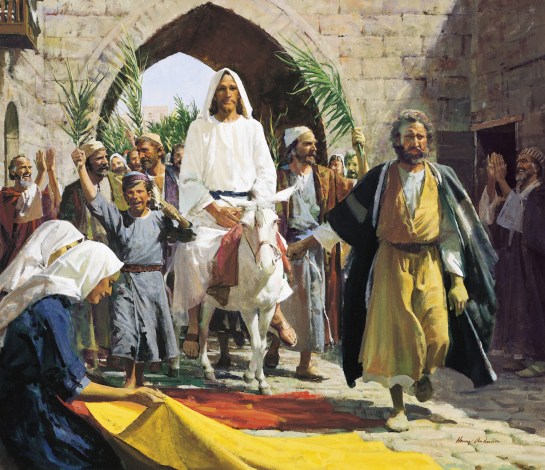
Jesus rides into Jerusalem (Matthew 21:4-5)


The first eight verses might seem obscure, but if you read on with patience the light grows stronger, and the presence of Jesus soon shines from the page.  Verse 9 tell of a King who will ride into Jerusalem upon a colt.  The entry into the city will herald a great victory and celebration.  The king on the colt will possess certain characteristics.  He will be just, endowed with salvation, humble, and a bestower of peace.

Imagine how Jesus felt when H read these verses. The fulness of time came, and He mounted a little colt outside Jerusalem and rose humbly into the city ready to die.

Surely this was one of Jesus’ favorite passages.  Which one is yours?  Do you have one?  Why not read it over today.  Better yet, share it with a friend.

David R. Denny  Ph.D.
Artwork:  https://www.lds.org/media-library/images/triumphant-entry-39581?lang=eng

Joyful Noise

Waywords

Psalms 100
Joyful Noise

11_kids_parade The homespun instruments were spread out on the sanctuary podium like dueling pistols awaiting a dawn adventure.  There was the cornet mouthpiece that you play like a kazoo.  Next to it was the toy drum and rattly toy tambourine.  Two tiny cymbals rested beside several dinner spoons serving as cymbal thumpers.  There were three recorders, a homemade dulcimer with a single twangy string, two cha cha Mexican shakers and a two-bit brass bell the size of a baby’s fist that I bought just the day before at a Saturday sale.

It was children’s church time in the morning worship service.  The kids sat in the front row twitching nervously, mischievously, as they looked first at the instruments then at the adults and then back at the instruments wondering if this was too good to be true.  That they could make noise, loud noise, wanton, reckless and uninhibited noise on Sunday morning was too much to grasp.

When the signal came, they surged forward, each child with an eager hand out hoping for just the right melody maker.  The bell went here, the cha chas went there, the cymbals to this one, the recorder to that one until every child had something.

Then they marched around the sanctuary.  Marching and playing.  Playing and marching.  The adults leaned sideways parting like the Red Sea as the parade passed.  Marching, smiling, smashing, blowing, tinkling, laughing, drumming and making happy childhood memories of being in church.


“Make a joyful noise unto the Lord all ye lands” (Psalms 100).


David R. Denny  Ph.D.
Cartoon by:
https://broomhillfestival.org.uk/event/childrens-parade/

Humility

 Waywords

Humility
John 13

After the introductory expressions of courtesy: the greeting, and the kiss, the Eastern guest was offered water for cleansing the feet.  Traveling down country roads made it hard to keep clean.  So it was customary for a host to provide this courteous ritual.  Servants would pour water upon their feet over a copper basin and then wipe them clean using a towel.  The best place to see this custom in action is in the upper room scene in John 13.

washing feet

“After that, He poured water into a basin and began to wash His disciple’s feet…”(John 13:5).

It was the evening of the Passover meal when the disciples entered the room selected for the occasion.  The memories of Bethany behind them now, the circle of disciples gathered to dine and wonder at the Savior’s intentions.

The table was set, and Jesus’ followers reclined around the triclinium.  Everything seemed ready.  The food was on the table and the evening seder was in progress ( καὶ  δείπνου  γινομένου).  Candles held back the darkness gracefully.  But where was the servant?  The pitcher was on the table near the entrance.  The water basin waited, untouched next to the linen cloth  (λέντιον) used for drying the feet.

But where was the servant?  A long and uncomfortable silence settled over the disciples.  It was the custom for a servant to wash their feet before they ate.  There was no servant.  No one moved.  How could they?  This task demanded a slave.  They were the future rulers of the new kingdom of Jesus.


triclinium

The triclinium of ancient Rome.

They grew impatient.  Furtive glances left and right brought no relief.  Someone would have to act, to go and find the tardy slave.

Scripture is majestic in its brevity here.  The text says simply that at this moment of crisis, in the servant’s absence, “Jesus rose from the supper.”  He knew His hour was here.  The Cross confronted him.  Time was accelerating now and the years of preparation thrust Him forward for life’s final crescendo.

Having yet to feel the cut of the spear’s cold edge and the calloused cries of the Roman soldiers, he knew these atrocities were near.  He knew yet He rose from supper and laid aside His garments.  He rose to gird Himself for this menial yet meaningful expression of spiritual intimacy.

The disciples noticed His preparation for the menial task immediately.  They knew His intentions, but no dared to stop Him at first.  Jesus removed His tunic.  He wrapped the long linen towel about His waist.  No one protested.  The light splash of water in the copper basin elicited no outward outrage.  The Son of God and right King of Israel became the absent servant.  In the flicker of the candle light, Jesus passed from king to servant.

Peter protested but quickly learned the higher lesson and relented embracing the touch of His master.  With a tenderness natural in solemn farewells, Jesus lingered before each man.  He poured the water, rubbed and dried the feet of each disciple.  And in this intimate expression of a Savior’s love for His closest friends, He pledged Himself anew to them all.  No words or oaths were sworn.  But there was a commitment extended that would span the ages.  In this solemn act, Jesus confirmed each disciple and conveyed the same love He offers to us each day.

David R. Denny  Ph.D
 Artwork from:
themastersmilitaryservicecenter.com
http://www.redeemerofisrael.org/2012/04/triclinium-passover.html


Prayer in Troubled Times

Waywords 

Elijah_w_Widows_Son_1080-256

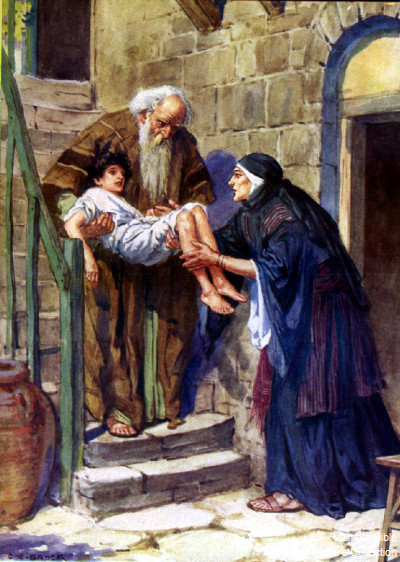
Elijah restores the widow’s son in Zarephath.

Prayer in Troubled Times
I Kings 17:17-24

The widow clung to the lifeless body of her son. All was gone now. The long sustained drought had wrung her soul dry leaving it crusted and crumbled. But at least through that horror, she had her son. But now he too was gone. The child had been her morning smile, her evening laughter, a reason for living. But now barren rooms in the small house were silent. He was gone, taken by some hideous sickness that struck without warning or mercy. And so all she could do now was to pace restlessly back and forth across the floor as if trundling from wall to wall could somehow erase the pain.

When Elijah stepped into the room, the widow’s reaction was instantaneous. She exploded, channeling a pent up rage at the prophet. “You call yourself a man of God? Look what has happened. My only son is dead. I took you in and look how you repaid me. It’s your fault he’s dead. You brought me bad luck. You put my son to death!”

The little widow turned the Prophet wanting only to be alone with her grief. Elijah, taken by surprise, paused for second to two and then stepped up to the woman. “Give me your son,” he demanded in a stern tone, indignation evident on his face. Elijah took the boy from his mother’s protective bosom and carried him upstairs to the upper room where he was living and laid him on his bed.

“Why, Lord, why did this happen?   Did you slay the boy?” The prophet pelted the Lord with edgy questions. He didn’t play games with God. He just wanted to know what happened, and he sought the core of the conundrum.

But then when the questions were exhausted, Elijah put aside his cross- examination of the divine mysteries and stretched himself upon the child three times. This time, he approached the Lord with a new intention. This time, he prayed. “O Lord my God, I pray Thee, let this child’s life return to him.

F. S. Webster said in his sermon Out of the Depths, “There are deep mysteries in life which yield to nothing but prayer.” And so it was that God heard this prayer and responded by breathing life back into the boy.

Elijah’s pattern of prayer is valid for us today. He prayed with a measure of frustration laced with honesty and doubts. Then he paused and prayed again with faith asking specifically for life.

So no matter how burdened your heart may become, let your final exhalation always be a prayer of faith and hope.

 David R. Denny Ph.D.
(Art credit:  http://bibleencyclopedia.com/pictures/1_Kings_17_Elijah_with_the_widow’s_Son.htm

Runaway

Waywords

Runaway
Philemon 1:10:  “…that I appeal to you for my son Onesimus,b who became my son while I was in chains.”

runawayOnesimus was a man in flight.  A runaway.  He felt caged at Colossae where he had lived as a slave in a Roman world.  Though he wore no chains, life’s limitations smothered him.  Considered nothing more than chattel, he served solely at the master’s whims and commands.  Life was a brutal monotony of ‘do this, do that’, bowing and scraping, honoring the fateful code of a sycophant, smothering beneath life’s limitations.


For weeks Onesimus lay awake at night scheming, thinking escape.  He knew the risks.  Punishments were severe for runaways. The slave hunters (Fugitivarii) would be searching for him.  If found, they would brand him on the forehead with the letters (FUG), an abbreviation for “fugitivus” meaning runaway.”  His bones would be broken to prevent any future attempts at escape.  (http://www.tribunesandtriumphs.org/roman-life/slave-punishment.htm).  None of this stopped him.  Freedom called.  Its voice was sweet.  The temptation to discover a personal liberty, a future with options, was too strong.

So he fled.  He stole some money from Philemon and ran toward Ephesus 100 miles away.  Each mile was a milestone.  Past, Laodicea.  Past Hieropolis.  He followed the Meander River as it rolled through the Lycus Valley seaward to Ephesus.  After days of overland struggle, he arrived and caught a ship for Rome, the furthest place on his map.  No one would find him there.

Onesimus ran from life’s tortuous ignominy.  But somehow in a  city of nearly a million residents, he met Paul, the slave of Christ, the prisoner of Rome and in this serendipitous encounter found his ultimate freedom.  He and Paul become best friends united in Christ.  Paul considered him a unique son (ὃν  ἐγέννησα  ἐν  τοῖς  δεσμοῖς, –birthed while he was in chains).

If your life is tough and you can’t breathe and you’re thinking about running remember the story of Onesimus and draw comfort. Somewhere out there is a Paul, a friend who understands your grief and who wants to help you.  And in your lowest moment when all hope is gone, turn your heart to Jesus who knows the meaning of pain and isolation and who longs to be  your friend and Savior.

David R. Denny  Ph.D


Obstacles

Waywords

Obstacles

Acts 13:6  They traveled through the whole island until they came to Paphos. There they met a Jewish sorcerer and false prophet named Bar-Jesus,…”

Every Christian journey has its share of obstacles. When Paul set out on his first missionary adventure, it wasn’t long before he stood face to face with an obstinate official named Bar-Jesus (Elymas).

obstacles

This reminds me of my old grandma’s outhouse in Georgia. When I was a kid, my family would visit Essie and I would have to get use

d to old time country ways, including the use of the outhouse. During the day it wasn’t so bad, but at night, without lights, the trip to the twilight zone was quite treacherous.

First, I had to step onto the back porch in the pitch black. With rotten boards and rickety steps, I took a real chance of falling through to the wet worm-patch below the porch. In the yard, there was a low-hanging clothesline

just waiting to hang any cavalier nightwalker out for a lark. There were holes in the dirt yard, big wood chips, and ax handles, and chickens to step over or around. And when I did get to the ramshackle outhouse, I ran the risk of snakes, or spiders, or worse–no paper.

Obstacles. That’s what these were. And in a way, that’s how it is for all who journey for the Lord today. Paul overcame this obstruction in Acts 13 by having the courage to face Elymas with faith and reliance in God. You can do the same things.

Happy journeys (and safe back-porch excursions).

David R. Denny  Ph.D.

Tangles

Tangles
Hebrews 12:1

“Wherefore seeing we also are compassed about with so great a cloud of witnesses, let us lay aside every weight, and the sin which doth so easily beset[1] us, and let us run with patience the race that is set before us,…”

tangles

I transferred a little glob of glue from my finger to my hair the other day by accident. Boy, what a mess! I couldn’t comb through it. I couldn’t untangle it. I couldn’t ignore it. So I took drastic action. I cut it out.

The word beset (KJV) in Hebrews 12:1 brings a similar image to mind. In this passage, the writer encourages us to run the Christian race without any weights, encumbrances or sin since these things tend to tangle us up. Just substitute the word tangle for beset and the intent of the writer becomes clearer.

If you have ever tried to run in your bathrobe, you know how difficult it can be. So an ancient runner with a long garment on would find his legs helplessly tangled and thus would never win a race.

Funny thing about spiritual entanglement: it happens all too easily and often. That’s why the effective Christian journey eludes so many. Just when a full stride begins, it falters unexpectantly, the victim of some new Satanic conspiracy. The dark world knows our foibles all too well, and only the disciplined saint knows how to react, how to counter and conquer.

And it’s not only individuals who get tripped up. Churches can have the same problem. A church can find itself tangled in all kinds of avoidable sins that cause anger and hard feelings among its members and its community. Pride, selfishness, power struggles, avoidance of newcomers, etc., are all tangles that can keep a church from running an efficient race.

Well, I looked a little funny for a week or two after I cut out my glue glob. My hair wouldn’t comb right. But the entanglement was gone. Sometimes you just have to pick up the scissors and cut. Entanglements can ruin a race.

Go ahead. Get the scissors. I’ll wait.

[1] εὐπερίστατον

Crisis

CRISIS           

       Seated in a window was a young man named Eutychus, who was sinking into a deep sleep as Paul talked on and on. When he was sound asleep, he fell to the ground from the third story and was picked up dead (Acts 20:9).crisis

Acts 20:7-12 is the context. Eutychus is dead on the church floor. So unexpected. So sudden. One minute he’s squeezed into a tiny window seal on the third floor listening to Paul drone on and one; the next minute he’s fallen asleep and tumbled to the ground. The church is in crisis. Who will tell his wife? What about his children? Quick. Call 911. Panic. Run!

So many crises seem to come out of nowhere. We don’t expect them, so we have no plan in place. Sometimes when disasters strike, the gut reaction is just to run. Bolt for the door. Leave it all behind somehow.

There are dangers, of course, to hasty getaways. When I was younger, I went to pick up my third-grade daughter from school. The rain had been falling all day, and the ground was soaked. Huge puddles were everywhere. Jessie came flying out of the school’s main entranceway so delighted to be through with the nasty process of learning. She was free! School was out. She leaped off the stairs at the front of the school and sailed gloriously face first into a monster puddle that was a good ten feet square and bottomless. I lost her for a second or two. I wasn’t worried. The unbroken principle of childhood is that all kids float in deep puddles. Sure enough. She bobbed up and learned a lesson, I think, about quick escapes.

Sometimes church problems can be overwhelming as well. There certainly was potential for hard feelings here in this congregation. It’s not fair to blame to Paul, but he was the one who called the meeting, and he was the one who spoke so long.

Well, go ahead and blame him or just run for the door. No one will stop you. It’s an easy way out. The air is cleaner in the streets. No decisions to make there. No Eutychian corpses on the quaint cobblestones outside. Dash for the door and leave the entanglements of friends and co-workers behind. Don’t worry about the damage to spiritual intimacy among your church family inside. Just run.

But wait. Paul’s not running for the door. He exudes spiritual strength. He picks the young man up and embracing him, infuses him with heaven’s breath. And within minutes Eutychus is sitting up embarrassed, apologizing, wondering about it all.

Next time a crisis strikes, remember Paul’s reaction of calm faith. It might be just the inspiration you need to survive.

David R. Denny
Waywords


Authors1